
- Over 1 million successful rentals
- Popular countries
- Popular regions
- Popular cities
- Popular airports
- Car Hire United Kingdom
- Car Hire Spain
- Car Hire Italy
- Car Hire France
- Car Hire United States
- Car Hire Portugal
- Car Hire Greece
- Car Hire Ireland
- Car Hire Cyprus
- Car Hire Switzerland
- Car Hire Germany
- Car Hire Croatia
- Car Hire Turkey
- Car Hire Canada
- Car Hire South Africa
- Car Hire Poland
- Car Hire Australia
- Car Hire Austria
- Car Hire Netherlands
- Car Hire Denmark
- Car Hire England
- Car Hire Scotland
- Car Hire Majorca
- Car Hire Florida
- Car Hire California
- Car Hire Crete
- Car Hire Sicily
- Car Hire Sardinia
- Car Hire Menorca
- Car Hire Wales
- Car Hire Kefalonia
- Car Hire Tenerife
- Car Hire Channel Islands
- Car Hire Corsica
- Car Hire Madeira
- Car Hire Gran Canaria
- Car Hire Azores
- Car Hire Santorini
- Car Hire Fuerteventura
- Car Hire Isle of Man
- Car Hire London
- Car Hire Faro
- Car Hire Malaga
- Car Hire Manchester
- Car Hire Alicante
- Car Hire Palma de Mallorca
- Car Hire Edinburgh
- Car Hire Dublin
- Car Hire Geneva
- Car Hire Nice
- Car Hire Paphos
- Car Hire Birmingham
- Car Hire Pisa
- Car Hire Milan
- Car Hire Lisbon
- Car Hire Glasgow
- Car Hire Orlando
- Car Hire Larnaca
- Car Hire Bristol
- Car Hire Rome
- Car Hire London Heathrow Airport
- Car Hire Faro Airport
- Car Hire London Gatwick Airport
- Car Hire Malaga Airport
- Car Hire Alicante Airport
- Car Hire Manchester Airport
- Car Hire Mallorca Airport
- Car Hire Dublin Airport
- Car Hire Edinburgh Airport
- Car Hire Nice Airport
- Car Hire London Stansted Airport
- Car Hire Pisa Airport
- Car Hire Paphos Airport
- Car Hire Birmingham Airport
- Car Hire Lisbon Airport
- Car Hire Larnaca Airport
- Car Hire Orlando International Airport
- Car Hire London Luton Airport
- Car Hire Geneva Airport (Switzerland)
- Car Hire Glasgow Airport
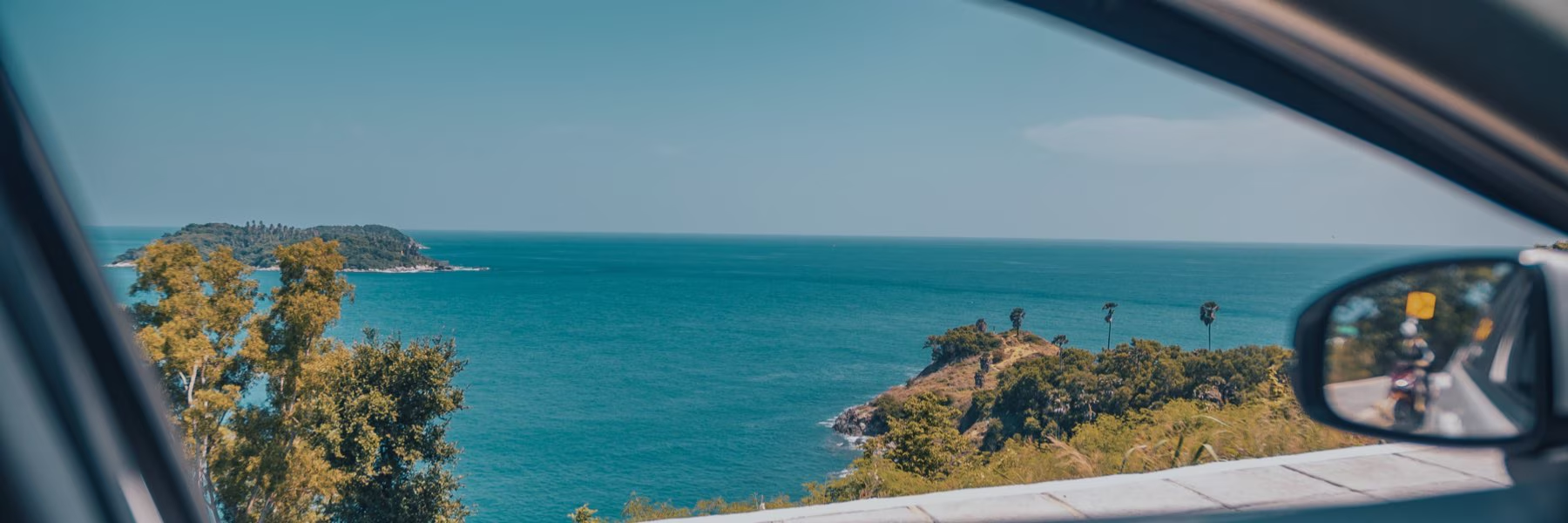
Car Hire Haiti
Save time and money. We compare the offers of car rental companies in Haiti on your behalf.
- Free cancellation Up to 48 hours prior to the scheduled pick-up time
- Best price guarantee Have you found a better price? Let us know and we will make you a better offer.
- 24000+ pick-up locations Locations around the world

Compare Car Hire
Carrentals.co.uk offers simple and straightforward car hire comparison services. We don't add a penny to your quotes!
Car rental locations in Haiti
Carrentals.co.uk compares rental car prices at the following destinations
Haiti Guide
Haiti is best explored by rental car. Carrentals.co.uk has over 1 pick-up locations in Haiti. This means there is always a pick-up location close to your destination.
Most popular car hire locations in Haiti
Driving
Haiti is one of the Caribbean's less travelled gems but those who dare to venture here won't be disappointed. This wonderful island is shared with the Dominican Republic. By car, tourists can explore the capital, Port-au-Prince, before getting out into the open countryside in order to discover natural wonders, secluded beaches and mountainous terrain.
Driving Tips for Haiti
Driving can be a challenge around the island as the roads are in poor condition following the 2012 earthquake. Signage is sparse and written in French. As most roads have potholes, it is advised to hire durable four-wheel drive vehicle.
Driving licences: a full UK driving licence or International Driving Permit is valid in Haiti.
Which side does Haiti drive on: the right.
Speed limits:
Dual carriageways and highways (outside urban areas): 75mph (120kph)
Provincial or national roads: 68mph (110kph)
Local roads: 50mph (80kph)
Urban roads: 31mph (50kph)
Alcohol limits: drink-driving is illegalâunlike in the UK, which has a limit of 0.08 percentâbut this law is rarely enforced.
Driving age: there is no minimum driving age, but car hire firms demand that drivers are at least 21 years.
Seatbelts: aren't required to be worn by either drivers or passengers but wearing them comes highly recommended due to challenging road conditions. The same logic applies to child restraints.
Mobile phones and GPS: drivers may use their mobile phone while at the wheel, but this practice isn’t recommended. GPS use is legal and can prove vital due to the scarcity of road signs.
Cost of fuel in Haiti: due to fluctuating pump prices, fuel may be considerably higher in price here than in Britain.
Car hire and fuel payment: those that wish to rent a vehicle will need to leave a cash deposit or produce a valid credit card. Petrol stations across the land are rarely able to accept credit cards so having enough cash to hand for fuel is advised.
Insurance: is not a common concept here so it is advised to take out full coverage. Most rental companies include basic liability of some description.
Traffic and parking: Haiti, especially the capital of Port-au-Prince, is notorious for traffic jams. On roads in the countryside, traffic comes in various different forms, ranging from livestock and pedestrians to broken-down vehicles. Parking is a free-for-all here.
Transport
Taxis
Taxis come in the form of trucks or SUVs, given the nature of the roads around the country. Prices are cheap compared to the UK. A typical fare for a guided trip around Port-au-Prince for the day could be as low as £6.
Buses
It is possible to get a bus here from the Dominican Republic. Caribe Tours runs once-daily coaches from the Dominican's capital, Santo Domingo, to Petionville at roughly £25 per person (one-way). Domestic bus travel is cheap, with fares around Port-au-Prince as little as £0.10, while tickets for the ride between Port-au-Prince and Jacmel are about £3.
Airports
Haiti has two international hubs: Toussaint Louverture International Airport near Port-au-Prince and Cap-Haïtien International Airport in the north. There are currently no direct flights from the UK but it is possible to fly to North American, Cuban or Caribbean cities with carriers such as United and American Airlines and then transfer. From the UK, a typical return fare costs between £600 and £800. British nationals aren't required to arrange a visa prior to travelling to Haiti. Taxis from Port-au-Prince’s airport to the city cost around £12.
Explore
Exploring Haiti
The majority of visitors to Haiti begin their explorations in the capital city, Port-au-Prince. Here, the main activities are trips to the National Palace, the Cathedral of Our Lady of the Assumption and the National Museum, which costs less than a bar of chocolate to enter.
After Port-au-Prince, tourists usually head to Cap-Haitien. The country's second largest city has an admirable location on the Atlantic coast. While there are things to do in the centre, most tourists use Cap-Haitien as an access point to Haiti's most beautiful beaches, while historians enjoy trips to the old forts.
Historians might also be interested in visiting Gonaives, the setting of the birth of the first-ever black republic in 1804 when Haitian Revolution leader Jean-Jacques Dessalines signed the country's declaration of independence.
A far cry from the hustle and bustle of Port-au-Prince are the towns of Jacmel and Jeremie. While the former is known for its beautiful historic centre and as the artistic and cultural capital of the country, the latter is one of the nation’s most isolated destinations, laden with friendly inhabitants.
Our Travel Editor’s Recommended Drives
Southern Coast – this shore boasts Victorian towns such as Jacmel as well as outstanding national parks like Park Macaya. Thankfully, the roads in this part of the country are much better than they are elsewhere.
Cap-Haitien – Haiti’s second city is much more relaxing than Port-au-Prince and provides an ideal base for excursions to the Citadel and idyllic beaches such as Plage Labadie.
The Southern Claw - this part of the country, known in short as the Claw, is home to cloud forests and jagged rock formations, in addition to some of the island's best bird-watching spots. The 'City of Poets', Jeremie, can be accessed via this route.
Saut-Mathurine - one of the Caribbean's most photogenic waterfalls is well worth the effort to get here. Its remote location means that it has been protected against harmful human intrusions.
Holidays and Festivals
New Year’s Day (1 January)
Ancestry Day (2 January)
Epiphany (6 January)
Easter (March/April)
Pan-American Day (14 April)
Labour Day (1 May)
Flag and Universities Day (18 May)
National Sovereignty Day (22 May)
Assumption of Mary (15 August)
Dessalines Day (17 October)
United Nations Day (24 October)
All Saints’ Day (1 November)
All Souls’ Day (2 November)
Armed Forces’ Day (18 November)
Discovery Day (5 December)
Christmas Day (25 December)
Weather
Haiti enjoys a typically tropical climate, meaning that warm temperatures are experienced throughout the year. Unfortunately, with this comes intermittent rainfall. As with many countries in this part of the world, location dictates minor variations in the weather. Along Haiti's coast, humid conditions are experienced. In the resorts located in the hills, temperatures are much cooler. The best time to avoid Haiti is between June and September, as this is when the hurricane season is in full effect. While there might not be any typical tourist season, December and February are considered the best months to visit and when temperatures regularly top 30°C.
Practical Stuff
Haiti Travel Tips
Whenever not in the clutches of a natural disaster, Haiti is arguably the Caribbean's most adventurous destination. Away from the gritty cities, the best locations are found well off the beaten path and boast unbeatable natural beauty.
Haiti contact numbers
Country code - (+509)
Emergency services – 114
Police – 114
Medical – 118
British Embassy – +509 3744 6371
British Consular Emergency Services – +509 3744 6371
Canadian Embassy – +509 2812 9000
US Embassy – +509 229 8000
Money matters
The gourde, the Haitian dollar and the US dollar are widely accepted here. Due to the unreliability of ATMs, tourists are advised to make sure they bring enough cash with them or sufficient travellers’ cheques, which can be changed in banks only.
Health and safety
The country's health problems have been worse than ever before since the 2010 earthquake. Visitors are advised to get the appropriate vaccinations for typhoid, diphtheria and hepatitis prior to travelling here. Due to the risk of cholera, only bottled water or fully-cooked food should be consumed. Malaria and dengue fever can be avoided by making sure skin is covered at sundown or sunup.
Fitting in…
Greeting Haitians is incredibly important, as is haggling with them over goods. Public displays of affection should be kept for private settings, as should donning skimpy clothing.
Visas for Haiti
Citizens of the UK, the EU, the US, Canada or Australia don't require a visa providing they stay in the country for less than 90 days. Having a passport that has six months’ validity is an entry requirement.
Electricity
UK and European travellers are advised to bring adaptors with them as flat pronged plugs are used here. The voltage is 220-110 at 60 Hertz.
Business hours
Shops: 08:00 to 12:00 and 13:00 to 16:00, Monday to Friday, 08:00 to 12:00, Saturday
Banks: 09:30 to 13:00 and 15:00 to 17:00, Monday to Friday
Helpful phrases
Bonjou – Good morning
Mesi – Thank-you
Souple - Please
Wi/non – Yes/no
Eskize mwen – Excuse me
Komon ou ye? – How are you?
Practical information
-
CurrencyHaitian gourde
-
Driving directionRight
-
LanguageFrench, Haitian
What most people want to know
The following questions and answers are a selection of the most popular questions. If you do not find the answer to your question, have a look at the Frequently Asked Questions page or contact us.
- Avis
- Budget
- Hertz