
- Over 1 million successful rentals
- Popular countries
- Popular regions
- Popular cities
- Popular airports
- Car Hire United Kingdom
- Car Hire Spain
- Car Hire Italy
- Car Hire France
- Car Hire United States
- Car Hire Portugal
- Car Hire Greece
- Car Hire Ireland
- Car Hire Cyprus
- Car Hire Switzerland
- Car Hire Germany
- Car Hire Croatia
- Car Hire Turkey
- Car Hire Canada
- Car Hire South Africa
- Car Hire Austria
- Car Hire Poland
- Car Hire Australia
- Car Hire Netherlands
- Car Hire Denmark
- Car Hire England
- Car Hire Scotland
- Car Hire Majorca
- Car Hire Florida
- Car Hire California
- Car Hire Crete
- Car Hire Sicily
- Car Hire Sardinia
- Car Hire Menorca
- Car Hire Wales
- Car Hire Kefalonia
- Car Hire Tenerife
- Car Hire Channel Islands
- Car Hire Corsica
- Car Hire Madeira
- Car Hire Gran Canaria
- Car Hire Fuerteventura
- Car Hire Isle of Man
- Car Hire Santorini
- Car Hire Azores
- Car Hire London
- Car Hire Faro
- Car Hire Malaga
- Car Hire Manchester
- Car Hire Alicante
- Car Hire Palma de Mallorca
- Car Hire Edinburgh
- Car Hire Dublin
- Car Hire Geneva
- Car Hire Nice
- Car Hire Paphos
- Car Hire Pisa
- Car Hire Birmingham
- Car Hire Lisbon
- Car Hire Milan
- Car Hire Glasgow
- Car Hire Larnaca
- Car Hire Orlando
- Car Hire Bristol
- Car Hire Rome
- Car Hire London Heathrow Airport
- Car Hire Faro Airport
- Car Hire London Gatwick Airport
- Car Hire Malaga Airport
- Car Hire Alicante Airport
- Car Hire Manchester Airport
- Car Hire Mallorca Airport
- Car Hire Dublin Airport
- Car Hire Edinburgh Airport
- Car Hire Nice Airport
- Car Hire London Stansted Airport
- Car Hire Paphos Airport
- Car Hire Pisa Airport
- Car Hire Lisbon Airport
- Car Hire Birmingham Airport
- Car Hire Larnaca Airport
- Car Hire London Luton Airport
- Car Hire Geneva Airport (Switzerland)
- Car Hire Orlando International Airport
- Car Hire Glasgow Airport
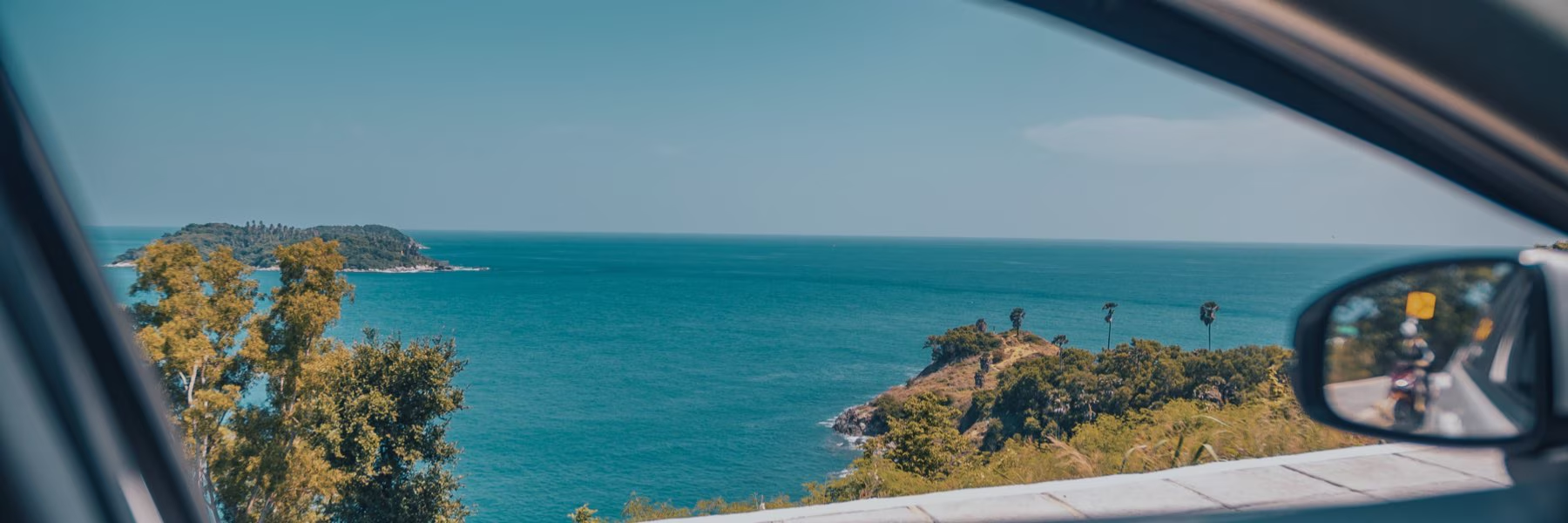
Car Hire Dominica
Save time and money. We compare the offers of car rental companies in Dominica on your behalf.
- Free cancellation Up to 48 hours prior to the scheduled pick-up time
- Best price guarantee Have you found a better price? Let us know and we will make you a better offer.
- 24000+ pick-up locations Locations around the world

Compare Car Hire
Carrentals.co.uk offers simple and straightforward car hire comparison services. We don't add a penny to your quotes!
Car rental locations in Dominica
Carrentals.co.uk compares rental car prices at the following destinations
Dominica Guide
Dominica is best explored by rental car. Carrentals.co.uk has over 1 pick-up locations in Dominica. This means there is always a pick-up location close to your destination.
Most popular car hire locations in Dominica
Driving
Known as the Nature Island of the Caribbean, Dominica is a paradise of beaches, volcanic crater peaks, lush countryside and one of the world’s largest thermal lakes. The island is basically a spectacular nature reserve crammed with exotic flora and fauna, and featuring charming towns, coastal highlights and quaint fishing villages. A well-maintained highway and smaller roads wind across most of the landscape, making self-drive exploration straightforward.
Driving Tips for Dominica
For the freedom to explore at will, self-drive wins hands-down, although roads in the more remote areas of this small island may be mud tracks suitable only for four-wheel drives. The switchback mountain roads and tracks make for an adrenaline-rich experience, and honking the horn at blind corners is local driving etiquette.
Driving licences: a valid UK driving licence gets you a temporary Dominican licence at the airport.
Which side does Dominica drive on: the left
Speed limits:
Cities and towns: 20 mph (32kph)
Open roads: as signposted
Alcohol limits: although there is no official blood alcohol limit in Dominica, the island’s National Drug Abuse Prevention Unit urges drivers not to drink and drive.
Driving age: most car hire firms require two years’ driving experience and a minimum age of 25 years.
Seatbelts: mandatory for drivers, although rarely enforced.
Mobile phones and GPS: mobile phone usage while driving is illegal unless a hands-free kit is installed. GPS units are fitted to a selection of rental cars and are legal to use.
Cost of fuel in Dominica: unleaded 95 octane and diesel are cheaper here than in the UK.
Car hire and fuel payment: a majority of petrol stations accept card payments, although rural outlets may require cash. Payment for car hire can normally be arranged by credit card.
Insurance: basic insurance is not required when hiring a car here; however, full insurance is highly recommended.
Traffic and parking: driving and parking regulations are not generally enforced and traffic congestion is almost unheard of.
Transport
Taxis
Taxis are good for limited exploration, but fares can mount up quickly and become expense, as they are charged per person and fixed by the government. However, rates for three or four passengers can be negotiated with the driver, softening the blow. Licensed taxi drivers are uniformed and the vehicle’s licence plate will start with ‘HA’ or ‘H’. Melville Hall Airport to Roseau costs around £12 per person. Taxi tours of the island for up to five hours’ duration can be had at around £60, with services stopping at 18:00.
Buses
Bus travel on Dominica is by privately-owned, relatively comfortable mini-vans with room for up to 15 passengers, with routes fanning out from the capital, Roseau, to most popular destinations. The Old Market Square and between the West and East Bridge are the main pick-up points, but flagging buses down at other locations works just as well. The vans are colourful, with licence plates beginning with ‘H’, and run between 06:00 and 19:00, Monday to Saturday. Fares start at £0.75 and increase up to £2.80 for a long trip.
Ferries
Trips to other Caribbean islands are easy by ferry from Roseau or Portsmouth town. The Caribbean Spirit ferry serves Marie Galante Island at around £65 return and also runs to the ‘Butterfly Island’ archipelago of Guadeloupe. Le Express des Isles offers a ferry to Fort-de-France on Martinique at £55.
Airports
Melville Hall Airport is the main air hub for Dominica and the closest airport to Roseau. It is set close to Marigot town, an hour’s journey by road from Portsmouth. American Eagle flies from San Juan (Puerto Rico), LIAT from Antigua, Barbados and St Lucia, BVI Airways covers St Martin and Conviasa flies from Polamer. The flight from San Juan to the island costs around £170 depending on the carrier and time of year.
Explore
Exploring Dominica
Exploring the mountains, rainforests, rivers, coastlines and lakes of Dominica is an eco-tourist’s dream, as most of the island and its flora and fauna are protected by law. Mome Trois Pitons National Park is a UNESCO World Heritage site for its Boiling Lake, Middleham Falls, Freshwater Lake, the Valley of Desolation and Boeri Lake, and offers rough, challenging but rewarding hiking trails which are best undertaken with a local guide.
Champagne, on the southern coastline, is a magical snorkelling spot, with its underwater volcanic vents aerating the water. From April to October, turtles arrive to nest, and whale and dolphin watching can be arranged in Roseau. The island’s central region is considered by many to be its most beautiful area. Hand-farmed in the traditional manner and with lush rainforests, its handful of quaint villages gives a step back in time.
The picturesque coastal fishing village of Scott’s Head is set on a magnificent semi-circular bay backed by mountains, and Roseau’s historic French Quarter holds pretty wooden homes and an impressive Gothic black-stone cathedral. Portsmouth, Dominica’s second-largest town, boasts an old British fort, and the Kalinago Barana Aute near Isukulati Falls displays the history and culture of the Carib peoples, Dominica’s original tribal inhabitants.
Our Travel Editor’s Recommended Drives
Jaco Falls - a well-known hiking destination but also accessible by car, the Jaco Falls are the perfect place for a picnic and a refreshing swim. However, the drive itself is the breathtaking highlight, with its soaring volcanic peaks, winding tracks through dense forests and spectacular views.
Northeastern Coastline - many of Dominica’s best white-sand beaches lie along the island’s northeastern coastline, overlooked by dramatic cliffs and the slopes of the mountains. Tiny, sheltered coves with fishing harbours support working fishing villages, and pretty Calabishie with its little eateries and stores is the area’s hub. Remote parts of the coastline were used as locations for the Pirates of the Caribbean films.
The Road to the Emerald Pool - the Emerald Pool is fed by a rushing waterfall, with the minerals in the water giving it its glowing green colour. Set in the mountainous centre of the island, the pool is accessed by a winding road leading from the Canefield Estate through rolling hills and palm-lined landscapes. After a swim, head back via the western road, which leads past traditional villages.
Holidays and Festivals
New Year’s Day (1 January)
Easter (March/April)
Roseau Carnival (March/April)
Labour Day (1 May)
Cochrane Rabbit Festival (5 August)
Independence Day (3 November)
World Creole Music Festival (26-28 October)
Christmas Day (25 December)
Weather
The island’s climate is tropical and generally less humid (with the exception of Roseau city) than many other tropical regions due to the northeasterly trade winds. Unfortunately, the cooling trade winds also invite devastating hurricanes from June to November. Visiting during the period of December to April is best, with daytime temperatures of around 26-28°C and less rainfall than in the summer and autumn months.
Practical Stuff
Dominica Travel Tips
Dominica is perhaps the Caribbean’s eco-friendliest destination, and its topography is unique in the region as the volcanic island is still forming. Birders should consider a visit to the island’s multi-layered, unspoilt rainforests for the imperial and red-necked parrots found nowhere else on earth. Ethnic history buffs will appreciate Dominica’s Carib territory, inhabited by the indigenous tribal Indians that were first discovered by Christopher Columbus in 1642.
Dominica contact numbers
Country code - (+1 767)
British High Commission – +246 430 7800
Australian Consulate - +246 435 2834
Canadian Consulate - +246 429 3550
US Embassy - +246 436 6300
Emergency services - 999
Money matters
Dominica’s official currency is the Eastern Caribbean dollar (EC$), although many outlets also accept US dollars. Banks are best for exchange rates, and ATMs and currency exchange outlets are found in the cities and at the airport. Most businesses accept major credit cards, although cash should be carried as well for small purchases, transport expenses and forays into remote areas.
Health and safety
Dominica is a safe country to visit and has no poisonous snakes or insects, although mosquitoes are known to carry dengue fever. Tap water is generally safe to drink, but bottled water is preferable for its taste. Basic healthcare is available in Roseau, but those on regular medications are advised to bring supplies. Driving at night is best avoided, as are dark streets, and petty crime including pickpocketing occurs in crowded tourism hubs.
Fitting in…
Horizontally laid-back people are a feature of this tropical paradise, with the helpful and friendly locals fun to be with whatever the occasion. Dress is an important cultural aspect here, with trendy-casual fine for drinks or dinner and beach gear just for the beach.
Visas for Dominica
Visitors from the UK and other British Commonwealth countries need only show a valid passport for visa-free entry here. Many other countries’ nationals, including those from EU member states, may also enter visa-free for a 21-day stay, and citizens of France may enter with an ID card for a 14-day visit.
Electricity
Electricity comes at 240V/50Hz, with sockets including the British three rectangular-pin outlets as well as the older British three round-pin type. A plug adapter is the best idea for all visitors, and those from North America will need step-down transformers if their electronic equipment from home is not configured to dual-voltage.
Business hours
Businesses: 08:00 to 17:00, Monday to Friday
Government offices: 09:00 to 16:30 or 17:00, Monday to Friday, some open Saturday mornings
Shops: 08:00 to 16:00, Monday to Friday, 08:00 to 13:00, Saturday
Banks: 08:00 to 14:00, Monday to Thursday, 08:00 to 16:00, Friday
Helpful phrases
English is widely spoken here due to the island’s years as a Commonwealth country, with Creole, a French-based patois, used as an everyday language by the citizens. A few words in Creole will help to break the ice.
Bon jou - Hello
Eskize mwen - Excuse me
Mwen pa konpran’n sa - I don't understand
Sa ki non’w - What is your name?
Merite - You are welcome
Wela… ? - Where is… ?
Mes - Thank you very much
Practical information
-
CurrencyEast Caribbean dollar
-
Driving directionLeft
-
LanguageEnglish
What most people want to know
The following questions and answers are a selection of the most popular questions. If you do not find the answer to your question, have a look at the Frequently Asked Questions page or contact us.
- Avis
- ACE Rent A Car